Cost Drivers Analysis   18-slide PPT PowerPoint presentation slide deck (PPT)
$39.00

Cost Drivers Analysis (18-slide PPT PowerPoint presentation slide deck (PPT)) Preview Image
Flevy is the marketplace for business best practices.
Cost Drivers Analysis (18-slide PPT PowerPoint presentation slide deck (PPT)) Preview Image
Arrow   Click main image to view in full screen.

Cost Drivers Analysis (PowerPoint PPT Slide Deck)

PowerPoint (PPT) 18 Slides

#1 in Cost Optimization $39.00
This presentation is created by former McKinsey, BCG, Deloitte, EY, and Capgemini consultants. It explains the approach to Cost Drivers Analysis utilized by global strategy consulting firms.
Add to Cart


Immediate download
Free lifetime updates

COST OPTIMIZATION PPT DESCRIPTION

Cost Drivers Analysis is an 18-slide PowerPoint presentation that explains the Cost Drivers Analysis approach used by global strategy consulting firms and was created by former McKinsey, Bain, BCG, Deloitte, EY, and Capgemini consultants. The deck teaches how to select, break down, quantify, and refine critical cost drivers and includes deliverables such as a Cost Driver Prioritization Matrix, Activity-Based Costing model, component breakdown templates, and sanity check guidelines. Target users include corporate strategists, financial analysts, operations leaders, and business unit managers; sold as a digital download on Flevy.
Use this deck when teams need to analyze relative cost structures at a business-unit or product level — for example during strategic planning, pre‑launch assessment, or operational efficiency reviews. Users include:
  Corporate strategists comparing business‑unit cost structures to inform competitive positioning during planning cycles.
  Financial analysts building cost driver models and quantifying competitor positions using detailed cost data.
  Operations leaders mapping value activities to cost drivers to identify productivity improvements.
  Business unit managers prioritizing cost reduction initiatives for a product line.
The four‑phase methodology—select, identify, quantify, refine—reflects the structured, hypothesis‑driven analysis common at McKinsey and BCG.

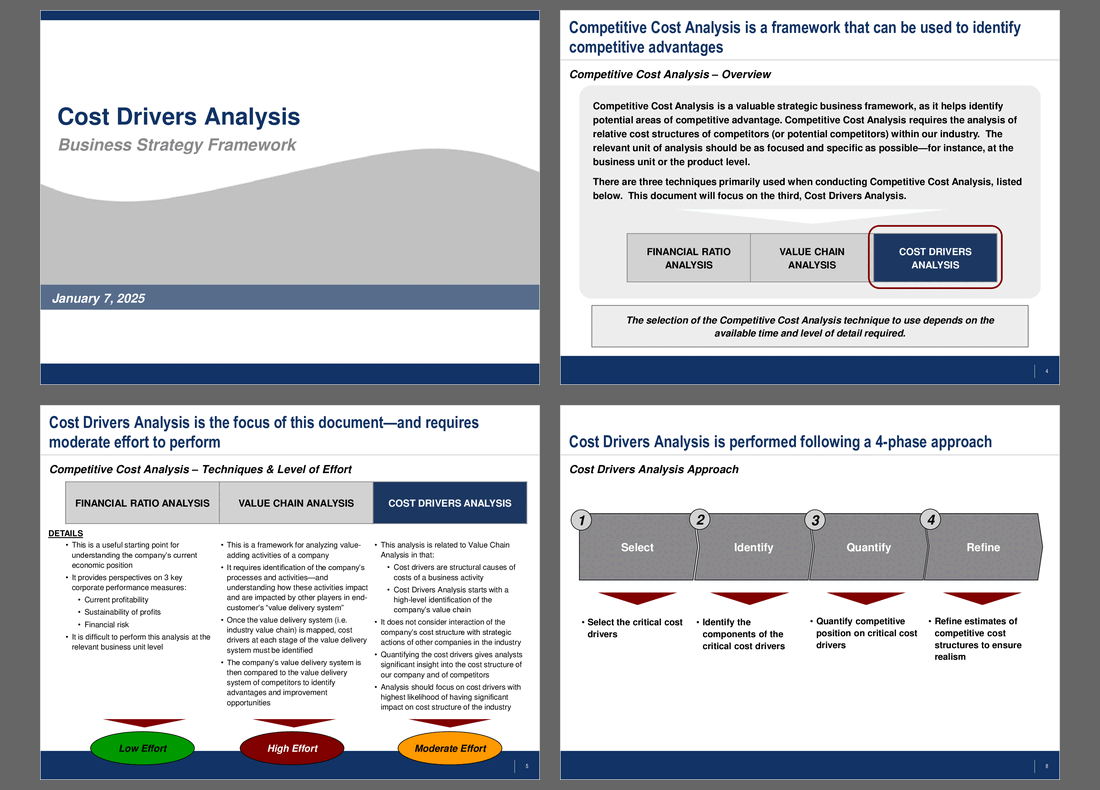
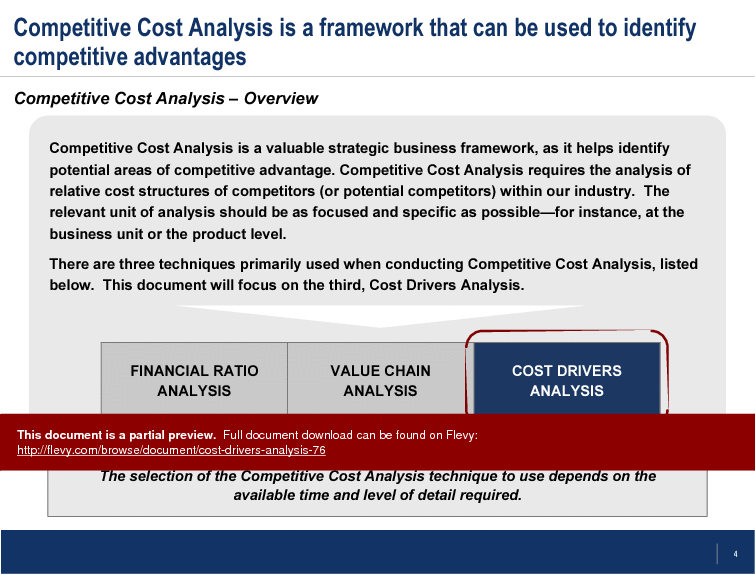
Competitive Cost Analysis is a valuable strategic business framework, as it helps identify potential areas of competitive advantage. Competitive Cost Analysis requires the analysis of relative cost structures of competitors (or potential competitors) within our industry. The relevant unit of analysis should be as focused and specific as possible—for instance, at the business unit or the product level.

There are three techniques primarily used when conducting Competitive Cost Analysis: Financial Ratios Analysis, Value Chain Analysis, and Cost Drivers Analysis. This document will focus on Cost Drivers Analysis.

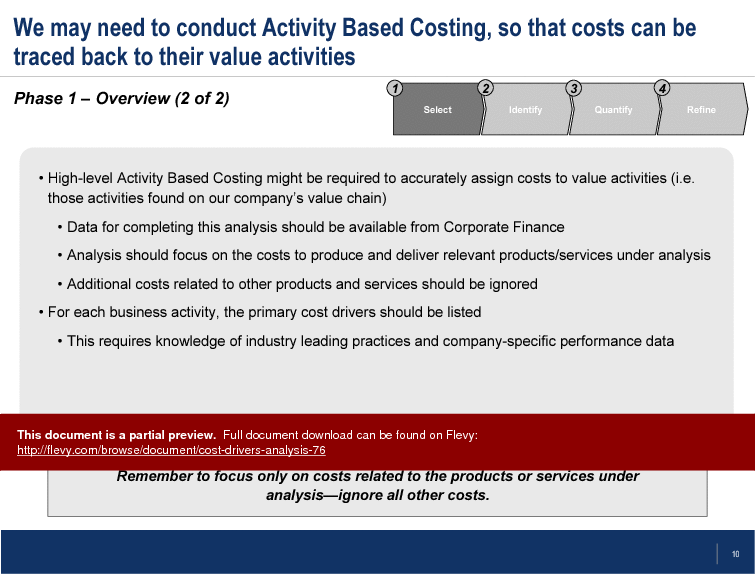
This document delves into the intricacies of Cost Drivers Analysis, offering a structured approach divided into distinct phases. Phase 1 emphasizes the necessity of Activity Based Costing to accurately allocate costs to value activities within the company's value chain. This phase underscores the importance of focusing solely on costs related to the products or services under analysis, ensuring that extraneous costs are excluded. The document highlights the need for data from Corporate Finance and knowledge of industry-leading practices to list primary cost drivers for each business activity.

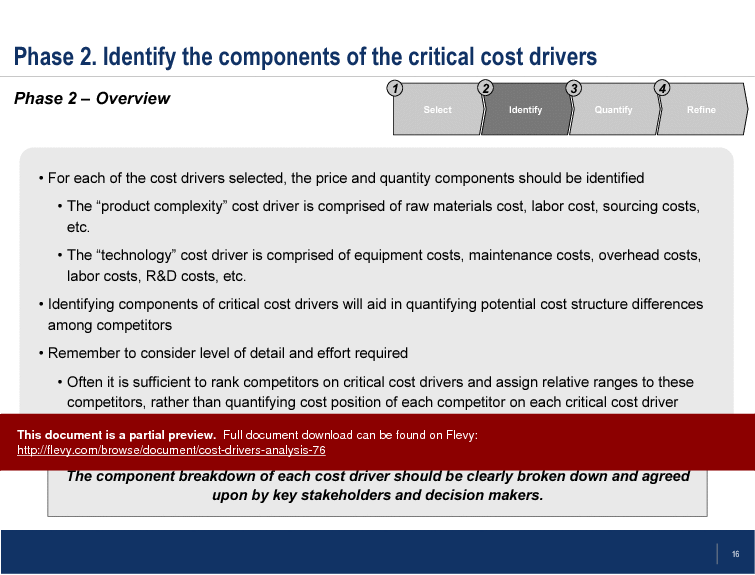
Phase 2 focuses on identifying the components of critical cost drivers, breaking them down into price and quantity elements. For instance, the "product complexity" cost driver includes raw materials, labor costs, and sourcing costs, while the "technology" cost driver encompasses equipment costs, maintenance costs, and R&D costs. This phase stresses the importance of considering the level of detail and effort required, advocating for ranking competitors on critical cost drivers rather than quantifying each competitor's cost position exhaustively.

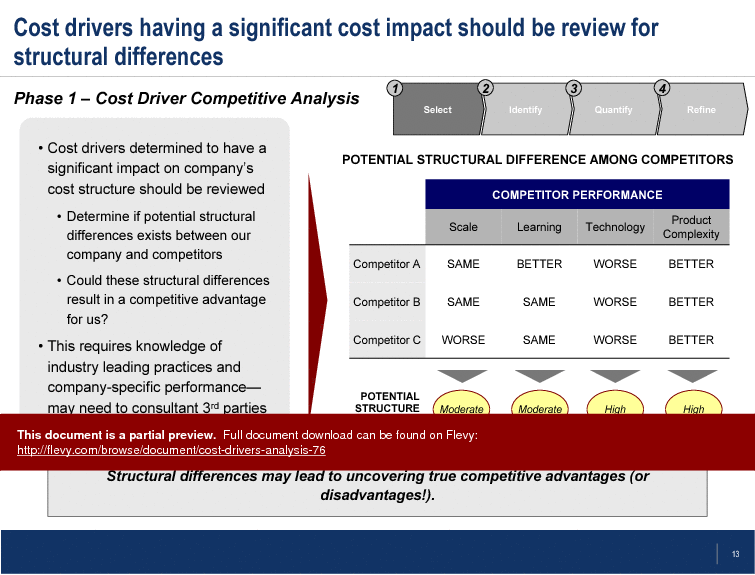
The document also covers the review of cost drivers with a significant impact on the company's cost structure for potential structural differences among competitors. This involves determining if these differences could result in a competitive advantage and may require consultation with third-party experts. The analysis aims to uncover true competitive advantages or disadvantages by examining potential structural differences in scale, learning, technology, and product complexity among competitors.

Got a question about the product? Email us at support@flevy.com or ask the author directly by using the "Ask the Author a Question" form. If you cannot view the preview above this document description, go here to view the large preview instead.

MARCUS OVERVIEW

This synopsis was written by Marcus [?] based on the analysis of the full 18-slide presentation.


Executive Summary
This Cost Drivers Analysis presentation is crafted by former consultants from McKinsey, Bain, BCG, Deloitte, EY, and Capgemini, embodying a consulting-grade quality (not affiliated). It serves as a strategic framework for identifying competitive advantages through a detailed examination of cost structures within an industry. Buyers will learn to analyze critical cost drivers, quantify their impact, and refine their competitive positioning, ultimately enabling informed strategic decisions regarding pricing and operational efficiency.

Who This Is For and When to Use

•  Corporate strategists focused on competitive positioning and cost efficiency
•  Financial analysts tasked with cost structure evaluation and optimization
•  Operations leaders looking to enhance productivity and reduce costs
•  Business unit managers aiming to identify improvement opportunities

Best-fit moments to use this deck:

•  During strategic planning sessions to assess competitive cost structures
•  When evaluating operational efficiencies and identifying cost reduction opportunities
•  In preparation for market entry or product launch to understand cost dynamics

Learning Objectives

•  Define the framework of Competitive Cost Analysis and its relevance to strategic decision-making
•  Identify critical cost drivers that significantly impact competitive positioning
•  Quantify the competitive position on selected cost drivers using detailed cost data
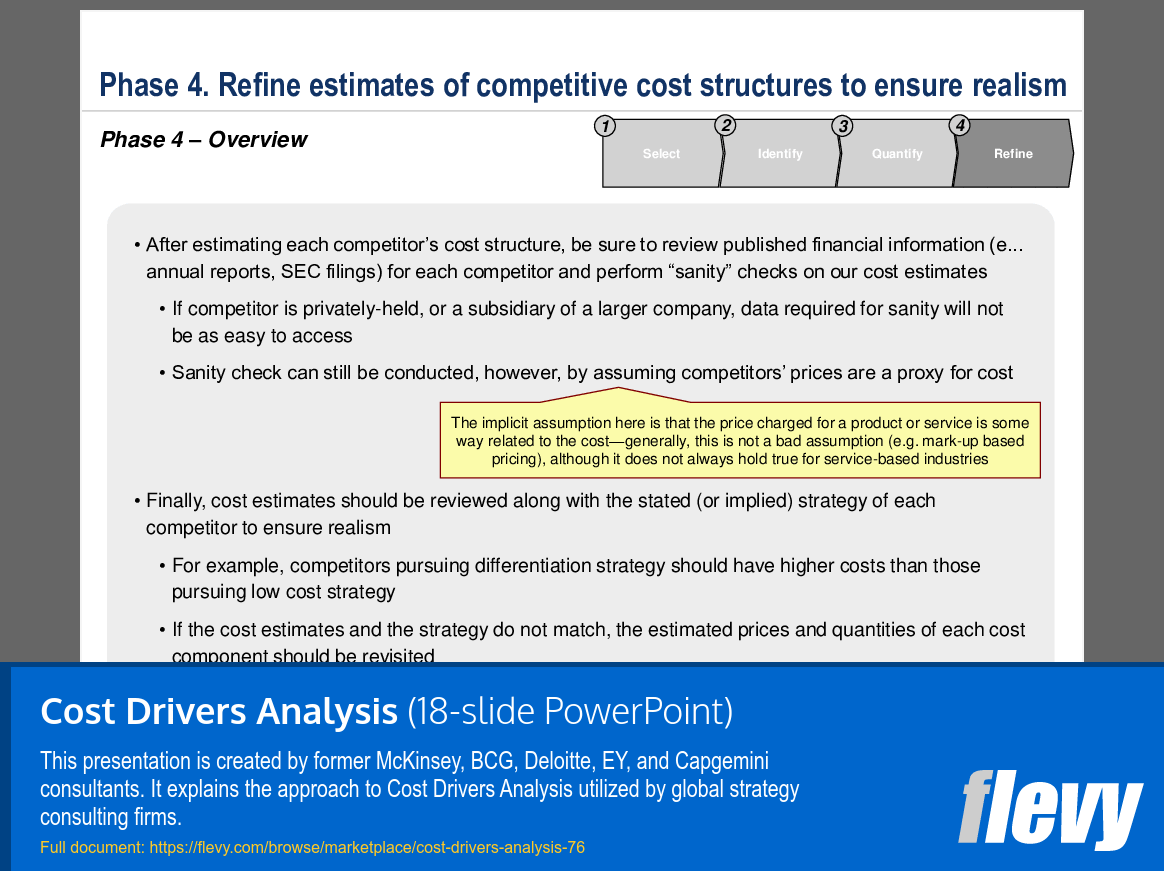
•  Refine estimates of competitive cost structures to ensure accuracy and realism
•  Analyze structural differences among competitors to uncover potential advantages
•  Develop actionable insights for product strategy and pricing decisions

Table of Contents

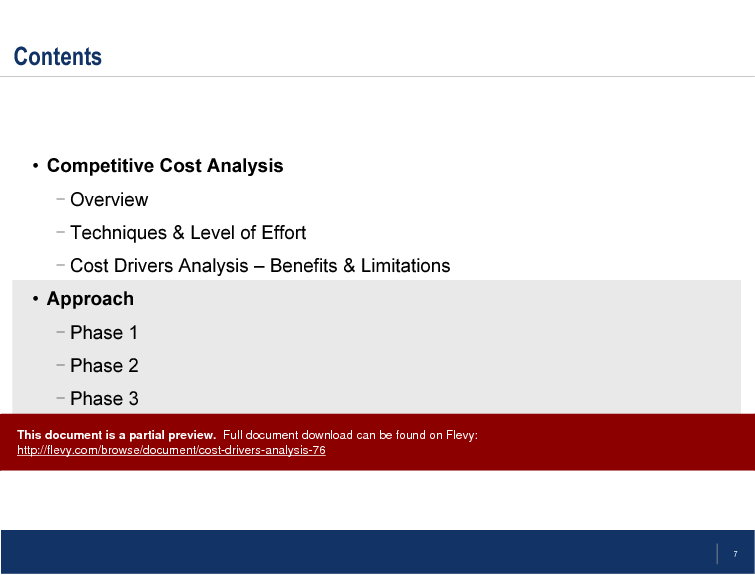
•  Competitive Cost Analysis Overview (page 4)
•  Techniques & Level of Effort (page 5)
•  Cost Drivers Analysis – Benefits & Limitations (page 6)
•  Approach (page 7)
•  Phase 1: Select the Critical Cost Drivers (page 9)
•  Phase 2: Identify Components of Critical Cost Drivers (page 16)
•  Phase 3: Quantify Competitive Position (page 17)
•  Phase 4: Refine Estimates of Competitive Cost Structures (page 18)

Primary Topics Covered

•  Competitive Cost Analysis Overview - This section introduces the framework for identifying competitive advantages through cost structure analysis, emphasizing the need for focused analysis at the business unit or product level.
•  Techniques & Level of Effort - Discusses 3 primary techniques for Competitive Cost Analysis, highlighting Cost Drivers Analysis as a moderate-effort approach that provides significant insights.
•  Benefits and Limitations of Cost Drivers Analysis - Outlines the advantages of identifying improvement opportunities while addressing the time-consuming nature of isolating cost drivers.
•  Four-Phase Approach - Details a structured methodology for conducting Cost Drivers Analysis, including selecting, identifying, quantifying, and refining cost drivers.
•  Cost Driver Identification - Focuses on the selection of critical cost drivers and the importance of mapping them to value activities for broader impact assessment.
•  Quantification of Cost Drivers - Describes methods for estimating competitive positions based on detailed cost data and production differences among competitors.

Deliverables, Templates, and Tools

•  Framework for Competitive Cost Analysis to guide strategic evaluations
•  Cost Driver Prioritization Matrix template for visualizing critical cost drivers
•  Activity-Based Costing model to trace costs back to value activities
•  Component breakdown templates for critical cost drivers
•  Sanity check guidelines for validating cost estimates against competitor data

Slide Highlights

•  Overview of Competitive Cost Analysis framework emphasizing its strategic importance
•  Techniques and effort levels comparison chart illustrating the focus on Cost Drivers Analysis
•  Benefits and limitations slide detailing the practical implications of the analysis
•  Four-phase approach diagram outlining the structured methodology for conducting the analysis
•  Cost Driver Prioritization Matrix showcasing the impact and likelihood of structural differences

Potential Workshop Agenda

Introduction to Cost Drivers Analysis (30 minutes)
•  Overview of Competitive Cost Analysis and its relevance
•  Discussion on the importance of cost structures in strategic planning

Phase 1: Selecting Critical Cost Drivers (60 minutes)
•  Identify and map cost drivers to value activities
•  Group exercise to prioritize critical cost drivers

Phase 2: Identifying Components of Cost Drivers (45 minutes)
•  Break down selected cost drivers into their components
•  Collaborate on identifying industry-specific factors

Phase 3: Quantifying Competitive Positions (60 minutes)
•  Develop cost driver models using detailed cost data
•  Analyze production differences among competitors

Phase 4: Refining Cost Structure Estimates (30 minutes)
•  Review and validate cost estimates against competitor data
•  Discuss implications for strategic decision-making

Customization Guidance

•  Tailor the Cost Driver Prioritization Matrix to reflect specific industry dynamics and competitive landscape
•  Adjust the component breakdown of critical cost drivers based on company-specific performance data
•  Incorporate company terminology and metrics to ensure alignment with internal processes

Secondary Topics Covered

•  Activity-Based Costing as a method for tracing costs to specific activities
•  Structural differences in cost drivers among competitors and their implications
•  The role of strategic actions in influencing cost structures
•  Industry-specific factors affecting cost dynamics and competitive positioning

Topic FAQ

What are the main phases of a Cost Drivers Analysis project?
Cost Drivers Analysis follows a four‑phase approach: select the critical cost drivers, identify components of those drivers, quantify competitive positions using detailed cost data, and refine cost structure estimates for realism. These steps constitute the framework described as the four‑phase approach.

How does Activity‑Based Costing feed into Cost Drivers Analysis?
Activity‑Based Costing is used to trace costs back to specific value activities, ensuring analysis focuses only on product- or service‑related costs. It requires collaboration with Corporate Finance and industry benchmarking to list primary cost drivers and is emphasized in Phase 1 of the approach, Activity‑Based Costing.

Which cost driver components should I expect to analyze?
Components are broken into price and quantity elements; examples include product complexity (raw materials, labor, sourcing costs) and technology (equipment costs, maintenance costs, R&D costs). The methodology advocates component breakdown templates to capture these elements like raw materials, labor, sourcing, equipment, maintenance, and R&D.

What should I look for when selecting a ready-made Cost Drivers Analysis toolkit?
Seek materials that map to a structured approach and include practical templates: a Cost Driver Prioritization Matrix, Activity‑Based Costing model, component breakdown templates, sanity check guidelines, and a workshop agenda. Flevy's Cost Drivers Analysis explicitly lists these deliverables and an 18‑slide PPT format.

How much effort does Cost Drivers Analysis typically require?
Cost Drivers Analysis is described as a moderate‑effort technique that provides significant insights,, but isolating specific cost drivers can be time‑consuming and requires detailed cost data and value‑chain mapping, making it a moderate‑effort approach.

I need to assess cost position before launching a new product—what approach should I use?
Use Competitive Cost Analysis at the product or business‑unit level, prioritize critical cost drivers, break them into price/quantity components, quantify competitor positions with production and cost data, then refine estimates via sanity checks. Flevy's Cost Drivers Analysis outlines this four‑phase process and related templates.

How do I validate cost estimates against competitors in an analysis?
Validate estimates by reviewing published financial information, performing sanity checks against competitor pricing and benchmarks, and, where structural differences are material, consulting third‑party experts. The deck includes sanity check guidelines to support this validation process.

What do ready-made Cost Drivers Analysis templates typically include, and which elements indicate higher value?
High‑value templates include an Activity‑Based Costing model to allocate costs to activities, a Cost Driver Prioritization Matrix for impact/likelihood ranking, component breakdown templates, and sanity‑check guidance. Presence of these tools, a clear four‑phase approach, and workshop materials indicate broader utility like the Activity‑Based Costing model and Cost Driver Prioritization Matrix.

Document FAQ

What is Competitive Cost Analysis?
Competitive Cost Analysis is a strategic framework used to identify competitive advantages by analyzing the cost structures of competitors within an industry.

What are the main techniques used in Competitive Cost Analysis?
The primary techniques include Financial Ratio Analysis, Value Chain Analysis, and Cost Drivers Analysis, with a focus on the latter for detailed insights.

What are the benefits of Cost Drivers Analysis?
Cost Drivers Analysis helps identify improvement opportunities, anticipate competitor reactions, and enhance product strategy decisions such as pricing.

What are the limitations of Cost Drivers Analysis?
Identifying cost drivers can be time-consuming, and without a well-developed value chain, the analysis may overlook critical opportunities.

How is Cost Drivers Analysis structured?
The analysis follows a four-phase approach: selecting critical cost drivers, identifying their components, quantifying competitive positions, and refining estimates for realism.

What is the significance of the Cost Driver Prioritization Matrix?
The matrix helps visualize the impact and likelihood of structural differences among competitors, aiding in the selection of critical cost drivers.

How do I validate cost estimates in Cost Drivers Analysis?
Review published financial information and perform sanity checks against competitor pricing to ensure the realism of cost estimates.

What role does Activity-Based Costing play in this analysis?
Activity-Based Costing helps trace costs back to specific value activities, providing a clearer understanding of cost drivers and their impact.

Glossary

•  Competitive Cost Analysis - A framework for identifying competitive advantages through cost structure evaluation.
•  Cost Drivers Analysis - A method for analyzing the structural causes of costs within a business activity.
•  Activity-Based Costing - A costing method that assigns costs to activities based on their use of resources.
•  Value Chain - A model that describes the full range of activities required to create a product or service.
•  Cost Driver - A factor that causes a change in the cost of an activity.
•  Prioritization Matrix - A tool used to rank cost drivers based on their impact and likelihood of structural differences.
•  Sanity Check - A method for validating estimates against known data or benchmarks.
•  Production Differences - Variations in production processes that can affect cost structures among competitors.
•  Component Breakdown - The detailed disaggregation of cost drivers into their constituent parts.
•  Strategic Decision-Making - The process of making choices that will shape the direction of an organization.
•  Operational Efficiency - The ability to deliver products or services in the most cost-effective manner.
•  Competitive Positioning - The strategy of establishing a brand or product in relation to competitors.

COST OPTIMIZATION PPT SLIDES

Four-Phase Framework for Cost Drivers Analysis

Framework for Analyzing Cost Drivers and Value Creation

Mapping Cost Drivers to Value Activities for Impact Assessment

Prioritizing Cost Drivers for Strategic Insights

Refining Competitor Cost Structures for Realism

Source: Best Practices in Cost Optimization PowerPoint Slides: Cost Drivers Analysis PowerPoint (PPT) Presentation Slide Deck, LearnPPT Consulting


$39.00
This presentation is created by former McKinsey, BCG, Deloitte, EY, and Capgemini consultants. It explains the approach to Cost Drivers Analysis utilized by global strategy consulting firms.
Add to Cart
  

ABOUT THE AUTHOR

Author image
Additional documents from author: 141

We are a team of management consultants trained by top tier global consulting firms (including McKinsey, BCG, Deloitte, EY, Capgemini) with a collective experience of several decades. We specialize in business frameworks based on real-life consulting engagements.

We have served 100s of clients that range from Fortune 500 companies to tech startups to ... [read more]

Ask the Author a Question

You must be logged in to contact the author.

Click here to log in Click here register

Did you know?
The average daily rate of a McKinsey consultant is $6,625 (not including expenses). The average price of a Flevy document is $65.

Bundle and save! You can save up to % with bundles!

View bundle(s)


Trusted by over 10,000+ Client Organizations
Since 2012, we have provided business templates to over 10,000 businesses and organizations of all sizes, from startups and small businesses to the Fortune 100, in over 130 countries.
AT&T GE Cisco Intel IBM Coke Dell Toyota HP Nike Samsung Microsoft Astrazeneca JP Morgan KPMG Walgreens Walmart 3M Kaiser Oracle SAP Google E&Y Volvo Bosch Merck Fedex Shell Amgen Eli Lilly Roche AIG Abbott Amazon PwC T-Mobile Broadcom Bayer Pearson Titleist ConEd Pfizer NTT Data Schwab


Read Customer Testimonials

 
"Flevy.com has proven to be an invaluable resource library to our Independent Management Consultancy, supporting and enabling us to better serve our enterprise clients.

The value derived from our [FlevyPro] subscription in terms of the business it has helped to gain far exceeds the investment made, making a subscription a no-brainer for any growing consultancy – or in-house strategy team."

– Dean Carlton, Chief Transformation Officer, Global Village Transformations Pty Ltd.
 
"One of the great discoveries that I have made for my business is the Flevy library of training materials.

As a Lean Transformation Expert, I am always making presentations to clients on a variety of topics: Training, Transformation, Total Productive Maintenance, Culture, Coaching, Tools, Leadership Behavior, etc. Flevy "

– Ed Kemmerling, Senior Lean Transformation Expert at PMG
 
"Flevy is now a part of my business routine. I visit Flevy at least 3 times each month.

Flevy has become my preferred learning source, because what it provides is practical, current, and useful in this era where the business world is being rewritten.

In today's environment where there are so "

– Omar Hernán Montes Parra, CEO at Quantum SFE
 
"The wide selection of frameworks is very useful to me as an independent consultant. In fact, it rivals what I had at my disposal at Big 4 Consulting firms in terms of efficacy and organization."

– Julia T., Consulting Firm Owner (Former Manager at Deloitte and Capgemini)
 
"I have used FlevyPro for several business applications. It is a great complement to working with expensive consultants. The quality and effectiveness of the tools are of the highest standards."

– Moritz Bernhoerster, Global Sourcing Director at Fortune 500
 
"I have found Flevy to be an amazing resource and library of useful presentations for lean sigma, change management and so many other topics. This has reduced the time I need to spend on preparing for my performance consultation. The library is easily accessible and updates are regularly provided. A wealth of great information."

– Cynthia Howard RN, PhD, Executive Coach at Ei Leadership
 
"FlevyPro has been a brilliant resource for me, as an independent growth consultant, to access a vast knowledge bank of presentations to support my work with clients. In terms of RoI, the value I received from the very first presentation I downloaded paid for my subscription many times over! The "

– Roderick Cameron, Founding Partner at SGFE Ltd
 
"As a consulting firm, we had been creating subject matter training materials for our people and found the excellent materials on Flevy, which saved us 100's of hours of re-creating what already exists on the Flevy materials we purchased."

– Michael Evans, Managing Director at Newport LLC


Save with Bundles

This document is available as part of the following discounted bundle(s):

Save %!
Competitive and Company Cost Analysis

This bundle contains 5 total documents. See all the documents to the right.

$129.00


Add Bundle & Save


Customers Also Bought These Documents


Customers Also Like These Documents

Explore Templates on Related Management Topics


Your Recently Viewed Documents
Receive our FREE presentation on Operational Excellence

This 50-slide presentation provides a high-level introduction to the 4 Building Blocks of Operational Excellence. Achieving OpEx requires the implementation of a Business Execution System that integrates these 4 building blocks.